Collaboration for Chocolate Makers: Making Chocolate with Alcoholic Beverages
Welcome back to Collaboration for Chocolate Makers, my new series in which we talk about how and why craft chocolate makers should we working with other businesses to expand their customer base, increase their revenue, and tell their story.
Today we’re going to talk about something central to Bean to Barstool: craft chocolate makers collaborating with beverage alcohol producers. In the last post, we looked at drinks-based options for these collabs. Today, we’ll look at chocolate-based collabs with breweries, distilleries, wineries, and other drinks makers. Refer back to the last post to read more about how and why these collaborations can be pursued.
Let’s look at how alcoholic drinks can be used in chocolate-making. Hopefully these give you some ideas for pursuing a collaboration!
Using Alcohol In Chocolate
The biggest challenge in making chocolate with alcohol is that you can’t use liquids in the chocolate-making process. Liquids cause the chocolate to “seize,” turning it into a sticky, clumpy mass. It is possible to add an extremely small volume of an alcoholic drink when tempering to round out flavors, but not enough to adequately infuse the full flavors into the chocolate. So how do craft chocolate makers get around this? Let’s look at some common methods.
Soaked nibs
By far the most common method overall for infusing alcoholic drinks into chocolate is by soaking cacao nibs. This involves steeping cacao nibs in the beverage of choice, allowing it to infuse for anywhere from a few days to a few weeks, and then drying the nibs out and continuing with the chocolate-making process as normal from there. This saturates the cacao nibs with the aromas of the drink without using liquid once the grinding process has begun.
Barrel-aging
Barrel-aging nibs allows the fats in the cacao to absorb the aromas of the wood itself and the spirit that was last aged in it. This isn’t as common as soaking, and typically takes much longer (up to 6 months). The flavor impact typically isn’t as intense as soaking, favoring nuance over impact, but has the added benefit of a more prestigious-sounding process for storytelling purposes. Not all alcohol drinks get barrel-aged though, so this limits available drink types.
Fillings
In the case of bon bons and filled bars, drinks can be used to make caramels, ganaches, reductions, and other fillings that allow the maker to skirt around the liquid prohibition by not infusing the chocolate itself.
Ingredients
Some makers forego using the drink itself and instead evoke the flavors of a particular drink by using one or more of that drink’s ingredients as infusions in their bar. This can include malt or malt powder, hops, wine lees, gin botanicals, and more. These can be used in a variety of ways. While only a few makers I’m aware of are doing it, it is also possible to soak sugar or milk powder in a spirit and use that in the bar.
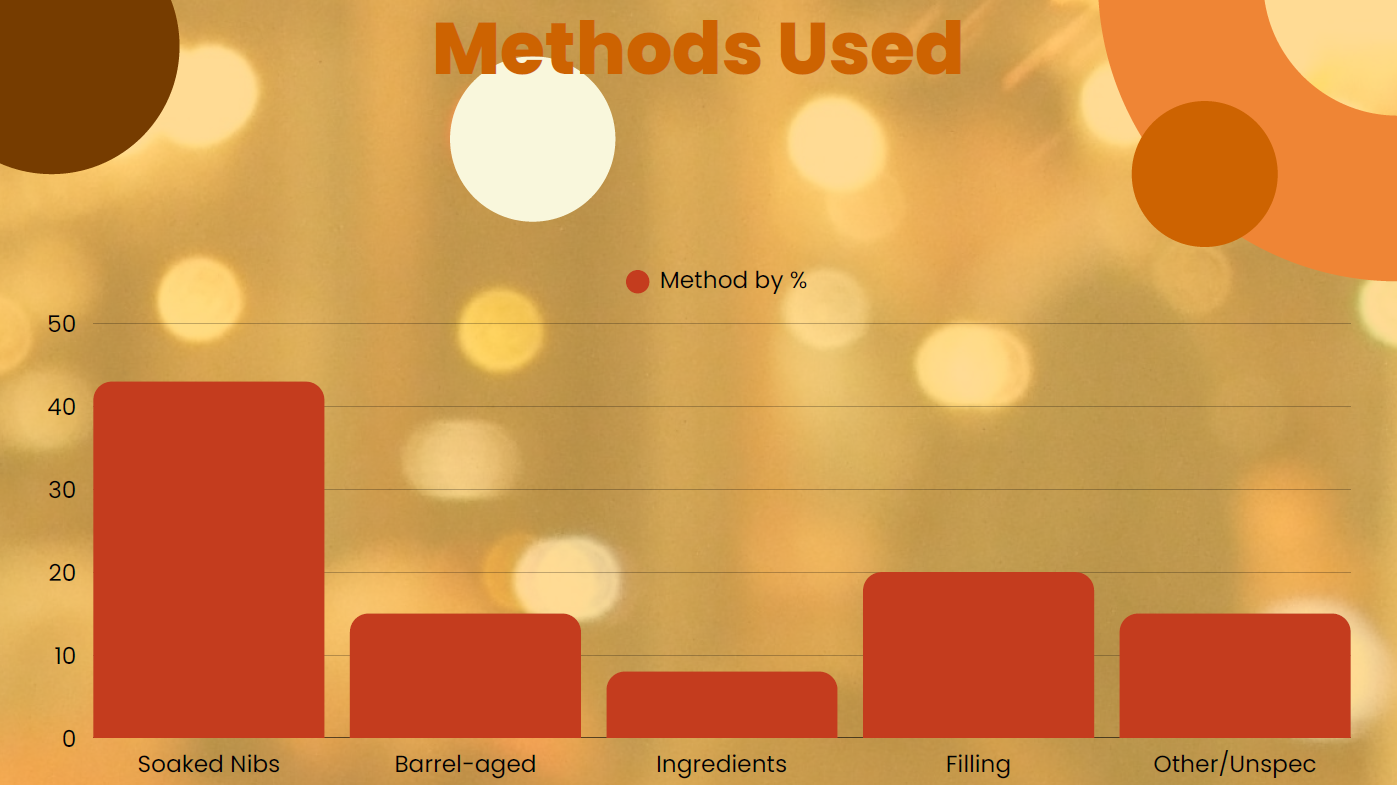
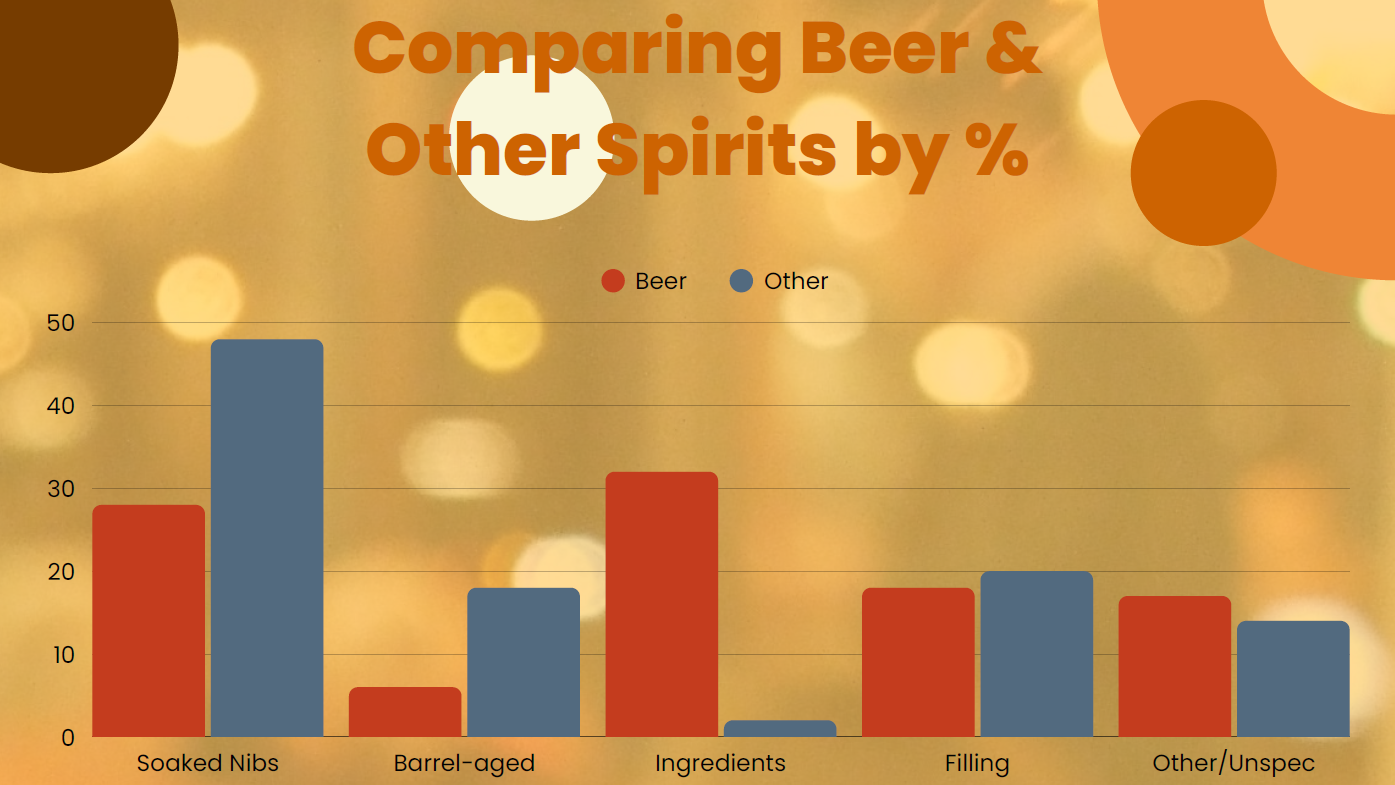
This graphic and others in this post are taken from a presentation I have given titled From Bean to Barstool and Back: Collaboration and Commonality Between Chocolate, Beer, and Spirits. All statistics are from my own tracking and are not from verified industry-level data.
Types of Drinks Used
When it comes to drinks-based collabs with craft chocolate, craft beer is the most common collab partner, but whiskeys are most common for chocolate-based collabs (with bourbon by far the most popular type of whiskey used). A lot of this has to do with cultural differences within these drinks segments around tradition and experimentation. Craft beer is generally much more open to playing with unexpected ingredients than the tradition-bound world of whiskey, so it’s easier for a brewery to brew with cacao than it would be for a distillery to add cacao nibs to a whiskey.
Whiskey
Culture isn’t the only reason whiskey is the most common spirit for infusing chocolate though. The flavors of whiskey—especially bourbon—are perfect for complementing many cacao origins.
Much of the flavor of most whiskeys comes from the oak it’s aged in. Common oak-derived flavors in bourbon and other whiskeys include caramel, coconut, vanilla, and baking spices, all flavors that easily dovetail with the flavors of good chocolate.
Additionally, bourbon in particular carries a significant prestige factor in American spirits, so working with a distillery can really benefit a chocolate maker on the marketing side.
When working with whiskey, by far the most common method is soaking nibs, but barrel-aging and fillings are also very common.

Other Spirits
While whiskey is most common, just about any spirit you can think of has likely been used in craft chocolate. Rum and gin are fairly common, and I’ve seen a lot of increase over the past couple years in mezcal bars.
Beer
Beer-flavored craft chocolate bars are quite popular—the second most common behind whiskeys—but we see an interesting contrast to spirits in how those flavors are achieved. While soaking nibs is relatively popular, by far the most common method for making these bars involves using beer ingredients rather than the drink itself.
Beer is unique among most alcoholic drinks in that it requires multiple different ingredients to make, and there’s a lot of variation within those ingredients. That complexity of options is why beer has so many completely different styles, from IPAs to Stouts to sours.
Because of this, many makers have opted to hone in on specific beer ingredients—hops especially—to make bars that are beer-inspired rather than beer-infused. This can be done by adding malt kernels, malt powder, or ground hops directly to the chocolate, but the method I’m seeing more and more of takes advantage of the aroma-absorbing property of cacao fat, much like when using barrels: hops aging.
Hops are flowers that lend a wide array of aromas and flavors to beer. Many chocolate makers are making chocolate bars and then packing hop flowers around them and sealing them for several weeks. The cacao butter in the chocolate absorbs these aromas, lending a bright, fruity, and floral array of aromas to the bar. Hops can also add bitterness to beer, but this aging method avoids any unwanted bitterness.
Craft chocolate and craft beer have a lot in common culturally, so collaboration between the two can be a natural and easy fit.
Wine and Cider
Wine has a lot of cultural cache, and many people associate wine and chocolate as complementary indulgences. Because of this, wine-infused bars are often an easy sell. While cider doesn’t share this association, it works in similar ways from a flavor standpoint in chocolate-making.
Soaking nibs in wine or cider is a common method for making these bars, and wine is particularly popular for making filled bars or bon bons. Wine barrel-aging can also be done, though it is less common than the other methods. Also, because wine barrels can be reused by the wine maker for quite a long time, a winery might be reluctant to part with a good barrel for a single collab.

Collaboration Process
In a chocolate-based collaboration with a drinks maker, the chocolate maker is, by necessity, going to shoulder a larger amount of the work than their collab partner. The product will obviously be made at your facility rather than the collab partner’s, and the burden of expertise will fall on you. That said, this can still be an invested creative collaboration.
Here are some recommended steps for how these collaborations can proceed after you’ve agreed to work together.
Create a Concept
Get together with the brewery, distillery, or other drinks maker and discuss what type of chocolate you’d like to make together. Discuss flavor concepts and even specific flavors, then decide on a final concept.
Discuss Methods & Ingredients
Discuss what processes and ingredients will be needed to achieve the agreed upon concept. In this step, you’re looking at broad categories; for example, you might decide you want to use hops-aged cacao nibs, but you don’t have to decide immediately on which cacao origin or hops variety. Some of the methods and ingredients will be dictated by the idea you’re working on, and some might have seasonal or time constraints.
Evaluate Ingredients
This might be the most fun part of all. Get together with your collab partner(s) and evaluate specific ingredients. This can be one of the most educational phases of the collab for both sides, as you not only both get a sensory lesson in ingredients you aren’t familiar with, but also get to discuss flavor and aroma with professionals from a different field, which can be eye-opening.
Depending on what you’re working with, this step can involve smelling hops, tasting specific beers, spirits, or other drinks, trying different chocolates or cacao nibs, and more. I highly recommend this step be shared together rather than siloing each collab partner to their own areas of expertise!
The Main Event
Once products, processes, and ingredients have been agreed on, and everything has been acquired and scheduled, you get to actually make the chocolate! While this process start to finish will obviously take several days, you can figure out which steps make the most sense for having your collaboration partner(s) present to help. If schedules don’t permit multiple points of involvement here, I would at least recommend they be present when their ingredient or product is first utilized. Even if there’s nothing for them to actually do, this can be a great opportunity to grab photos and videos for social media. Remember, the collab continues after the product is released.
Final Thoughts
Not only do drinks-infused or -inspired chocolate bars offer a ton of storytelling opportunities and potentially reach new audiences, they can be a pretty easy lift. A ton of makers are already making these bars, but aren’t necessarily leveraging the marketing opportunities of a branded collab. You might be able to expand the benefits of these bars just by approaching and formalizing the partner relationship!
Collaboration for Chocolate Makers series
Podcast Episodes
Why Do It, and General Considerations
Collaborating with Beverage Alcohol Producers
Collaborating with Other Craft Chocolate Makers
Creative Collaborations to Consider
Collaboration Case Study: Estelle Tracy
Blog Posts
Why It’s Worth It, and Things To Consider
Collaborating with Beverage Alcohol Producers, and Drinks-Based Collabs
Chocolate-Based Collabs with Beverage Alcohol Producers (you’re reading it!)
Collaborating with Other Craft Chocolate Makers
Creative Collaborations to Consider
Collaboration Case Study: Estelle Tracy