Media Relations for Craft Chocolate Makers: How (and When) to Send Press Releases
by David Nilsen
Welcome to our Media Relations for Craft Chocolate Makers series! As a food and beverage journalist, I have communicated with thousands of breweries, distilleries, restaurants, chocolate makers, and other businesses, and I’ve seen ones who maximize their relationships with media members and outlets, and ones who are leaving opportunities on the table. Additionally, my wife and business partner, Melinda Guerra, is a freelance PR professional helping brands tell their stories and connect with media. In this series, the two of us will be sharing what we’ve learned over our careers to help craft chocolate companies of any size identify their stories, communicate them to media members and outlets, gain new customers, and keep the ones you have curious.
In part 1 of this series, we talked about why media relations is so important no matter the size of your chocolate business, and why you need to have a strategy for it.
In part 2, we talked about identifying stories and creating a story list.
In part 3, we looked at how to begin building a media list, and how to specifically build a list of industry-specific media.
Today, we’re going to talk about press releases: What they are, when to send them, to whom to send them, what to include, and—just as importantly—the inverse of all those: when not to send them, what not to include, etc.
Making and sending a press release can feel scary if it’s not something you do all the time. It can feel like filing taxes or turning in an application, and if you don’t do it exactly right you’ll be in trouble. They don’t have to be scary though, and, as we’ll learn, they don’t have to be all that often either. Sending a press release sounds super official, so it sounds like the thing real professionals do, but as we’ll discuss, there are pretty specific times to send these and the rest of the time they may not be necessary.
When To Send a Press Release
There are two pretty specific situations for sending press releases, according to public relations pro Melinda Guerra.
Events and Timely News Stories. If you have an event coming up you think the public should know about, or an announcement that has either a specific call-to-action or time-sensitive component, that’s a good situation for sending press releases to the media rather than more informal communication.
Introducing Your Business. If you have to get your company on the radar of local news outlets, you can send a press release formally introducing them to your business. Once you have these distributed, you can also host them on a dedicated page on your website, which allows you to have information about your company or products online in an accessible place for media who need to verify basic information in the future.
In short, press releases are always for a specific purpose, whereas informal communication can be more general. Said differently, press releases are for news rather than ongoing stories.
To Whom To Send Press Releases
Provided you know when to send them, you can potentially send press releases to any relevant media member or outlet. That said, they are typically uniquely useful for local and legacy news outlets, or industry news aggregators.
Local News. Local television stations and newspapers are always on the lookout for interesting things happening in their communities, because consistently providing this information makes them a trusted and integrated part of their followers’ lives. Often a news source will provide specific instructions for sending events announcements and other types of news, so make sure you follow any provided instructions.
Online publications: Local news websites or industry news aggregators (we’re still waiting for one in the craft chocolate industry) sometimes opt to publish press releases directly rather than editorialize them, so they sometimes have specific forms to fill out to submit them. Again, follow any provided instructions.
Other Media. While the timeliness angle is typically not as applicable for most freelance journalists and other media outlets, they’ll still be interested in your press releases…under one major condition. Make sure you know the journalist’s or outlet’s beat, and don’t send them unrelated press releases. Breaking this rule is a great way to get your future correspondence ignored.
How To Put Together a Press Release
No one likes getting spammed, and no one likes feeling like they’re just one email address on a long, impersonal list of contacts. When you’re sending press releases, try to send these individually, and include very brief (1-2 sentences) ,personalized messages at the beginning. If you absolutely must send these as a mass mailing, be sure to enter email addresses under BCC instead of CC.
Every press release needs to include the following information:
- Contact name and title at your company for following up
- Contact email and phone number. This needs to be an actual individual’s email address, and it needs to be checked more than once a day (more on that later).
- Company name (yes, people really do forget to include this sometimes)
- Product name or event title
- A brief, factual description of what’s being promoted
All of this should be provided succinctly. Remember the person reading this is busy, and yours isn’t the only press release they’ve gotten today.
Things NOT to include in a press release:
- Unverifiable superlative language (e.g. “we’re using only the best ingredients”).
- Slick PR-speak that makes this sound like an advertisement (e.g. “this is revolutionizing the industry”).
- Industry-specific terminology the recipient might not be familiar with, unless you can explain is succinctly.
- AI-generated text or graphics. If you don’t care enough about this to put it into your own words, why expect anyone else to?
How To Format a Press Release
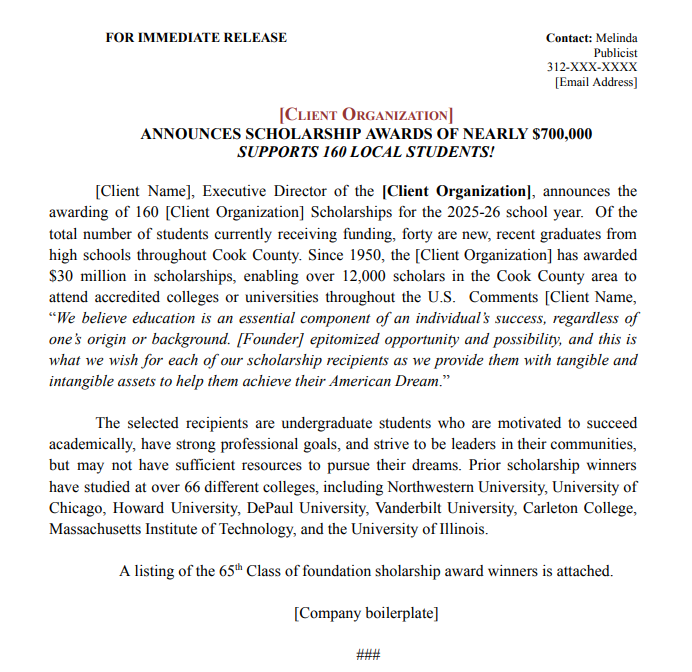
From top to bottom, here’s how you should lay out your press release:
- Contact info (name/title/phone/email
- Headline and subtitle that summarize the story
- Photo if being used (more on this later)
- City/location (if it’s an event announcement)
- The written body of the press release itself
If this is for an event, the body text needs to answer the What/When/Where/Why of the event, and also needs to include information on where media trucks can park to set up, and who will be the onsite media contact for the event. Finally, it will explain why this event matters, and what will be involved.
If this is for a product, the body text needs to answer Who/What/Why. Make sure to name the product, explain what it is, and give details on how to purchase it.
Generally, the body of a press release should be 3-4 short paragraphs, and include 1-2 quotes from someone at the company, if possible. It’s okay if this is you and you’re also the person sending the press release.
Next, include a Dropbox or related link that includes more photos (make sure your settings don’t allow anyone to delete or modify contents!)
Finally, the bottom of your press release should have a brief, boilerplate description of your company the media can use to explain who and what your company is.
With everything above, make sure everything you include is factual and accurate, and keep it brief. You’re not writing the story, you’re providing what someone else will need to write or tell the story.
When you’re actually sending the press release, you can generally put them directly into the body of the email rather than including it as an attachment. Linked press release can be referring to in future correspondence if needed.
Here’s an example press release to take a look at:
What Photos or Visuals to Include
Melinda generally embeds a single image before getting into the copy of the main press release. This can be an event graphic, or a headshot or product shot. Make sure to keep these relatively small so they don’t get flagged by email filters with size restrictions. A Dropbox or similar link to more photos or assets (logos, etc) can then be provided at the end of the press release. It’s important that you also provide attribution details for any photos you share with media, even if the photos are attributed to your company.
It can be a good idea to have a media kit prepared to include with a press release. This is a linkable location that contains headshots and professional bios for relevant team members, a brief history of the company, professional product shots, a boilerplate description of the company, hi-res company logos, and accurate website and social media links, as well as contact names, titles, emails, and phone numbers.
It should go without saying that this should all be checked and update for accuracy regularly.
What Are Embargoes, and When To Use Them
An embargo is a media-specific term that refers to when a company wants to make the media aware of coming news, but aren’t ready for that news to be shared until a specified date. For example, a company might let the media know a new CEO is being announced, or a new product lines is being released, but wants to make that announcement formally before media shares it.
You should almost never use an embargo. They are inconvenient for media members and outlets, and the reasons for using them are rarely as significant as they can feel. Yes, it can be nice to have total control over when your news gets shared, but out in the real world, no one really cares when and where they heard about these details, it only matters that they do hear them. Putting restrictions around when that happens reduces the likelihood it will.
There are rare instances when you can embargo news, but think very carefully about whether it’s truly necessary.
Media Alerts
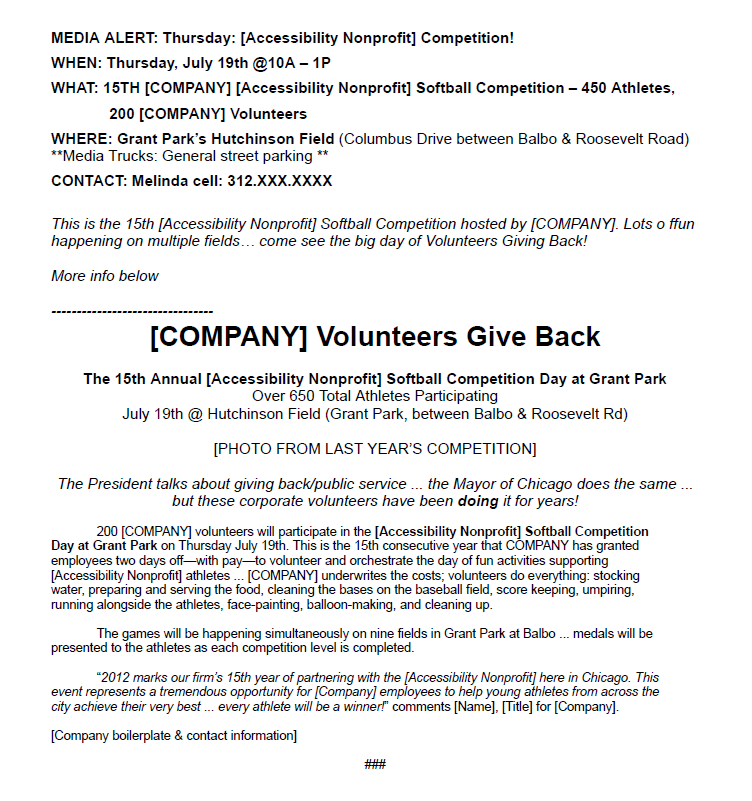
After Melinda has sent formal press releases for events, she will often follow up a couple days before the event with a media alert. This is just quick reminder about the event. It doesn’t contain all the text of the original, but does repeat necessary info such as:
- Event Date
- Onsite contact (This needs to be someone who can answer Every Single Call as soon as it happens, so it shouldn’t be the speaker, company president, etc).
- Two sentences about event
- Parking information
- After a dividing line or series of dashes, she’ll then provide a little more additional info about the project if they want more background for their story.
Here’s an example media alert:
What’s Likely To Happen Next
If writing press releases isn’t a regular part of your work life—and it probably isn’t—it’s likely not something you love doing. Once you’ve clicked Send, you probably want to forget about it and move on. Unfortunately, the life cycle of that press release isn’t over.
Once you send a press release out, you need to be ready to receive emails or calls from the media. It’s important to remember the press release is not the story—the press release gets you the story. Local news is almost invariably operating on tight timelines and deadlines, so if you wait to respond to their communication, they will most likely move on from the story, and the work you’ve already done will have been wasted.
When you send a press release, you need to be monitoring the email inbox and phone you provided as contact info, and you need to respond to any communication within an hour or two. Yes, this is inconvenient. But if you aren’t prepared to do this, there is no point in sending the press release in the first place. Remember, media contacting you is the entire point of doing this!
If media follows up on your press release (congratulations!), you need to be ready to provide any necessary information about the event or news, and to provide a quote or two. Because it’s easy to feel flustered in these moments, it can be good idea to have all of this already prepared and easily accessible.
While this will be professional and efficient communication, you should still be friendly and easy to work with. Don’t make the media member feel like they’re inconveniencing or bothering you by reaching out. That’s what you want them to do!
It’s also important to manage expectations when you send out a press release. Most of the people you contact likely won’t respond. Some of the ones who do will ultimately fall through. When you get coverage, it may or not be as extensive or effusive as you wanted. The goal is visibility and awareness through a vetted source—any positive coverage is good coverage.
If you have any questions about press releases, please reach out and let me know, and Melinda and I will answer them!
Media Relations for Craft Chocolate Makers series
Podcast Episodes
Why You Need a Media Plan
Identifying Your Company’s Stories
How to Build and Manage a Media List
How to Write and Send a Press Release
How to Maintain Media Relationships and Communicate New Stories
How to Get Started, and Common Pitfalls
Blog Posts
Why You Need a Media Plan
How to Identify Your Stories
How to Build a Media List
Industry and Unexpected Outlets for Your Media List
How to Write and Send a Press Release (you’re reading it!)
How to Maintain Media Relationships and Communicate New Stories
Crisis Communications
What To Do After You Get Media Coverage
Common Pitfalls, and Easy Steps for Getting Started